
Visual Thinking, Fringe Attention, and a Search for Monsters
Why the early stages of the creative process need their own visual tools

Over the last few weeks I found myself in a weird mental space I don’t often frequent. The first thing I did when I got there, was frantically look around for an exit.
The exit strategy:
Develop a focusing question, apply a problem solving visual tool, and write about it.
Just to back up a bit for context - that was the first leg of a recent 6-week creative sprint thrown by Dave Gray. My chosen ocean of exploration: Visual Thinking and Visual Storytelling.
By the end of that first leg I wondered, what the heck caused my initial panic?
So I made a sharp U-turn, back to the space before any questions were formed, to see what monsters might be lurking there.
I’m happy to report that I found the panic inducing monster, understand finally why hanging around in these weird mental spaces is important, and I discovered some visual tools that might actually work there.
Exploring the Shape of The Creative Process
I routinely gravitate to the problem solving process. Knowing it fits into a larger creative process, I zoomed out to explore what the wider picture looked like.
What did creativity thinkers agree on, and where did they diverge?
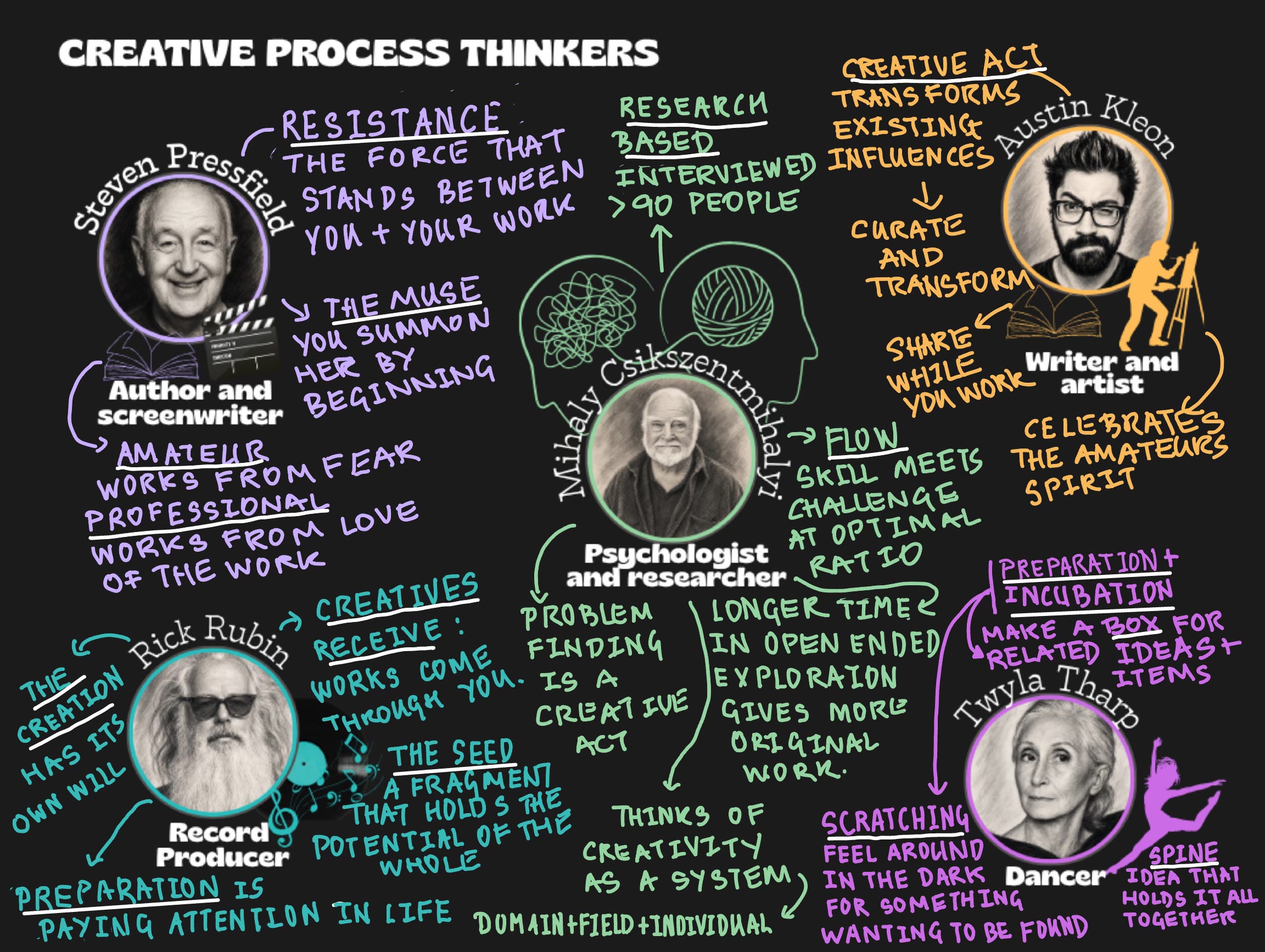
Mihaly Csikszentmihalyi in particular, studied creativity across artists, scientists and business people - he illustrates that the creative journey isn’t just for “creatives.” It applies to all of us.
Trying to map the act of creation is like unravelling a strand of DNA. The sequence may become easier to follow, but some of the information gets lost. While it cannot capture the whole mystery of creation, a simplified map can help orient us via landmarks.
Despite their different framing, thinkers like Tharp, Kleon, Pressfield and Rubin (captured in the above visual), all describe roughly similar (or subsets of ) aspects outlined by Csikszentmihalyi:
Preparation → Incubation → Insight → Evaluation → Elaboration → Sharing
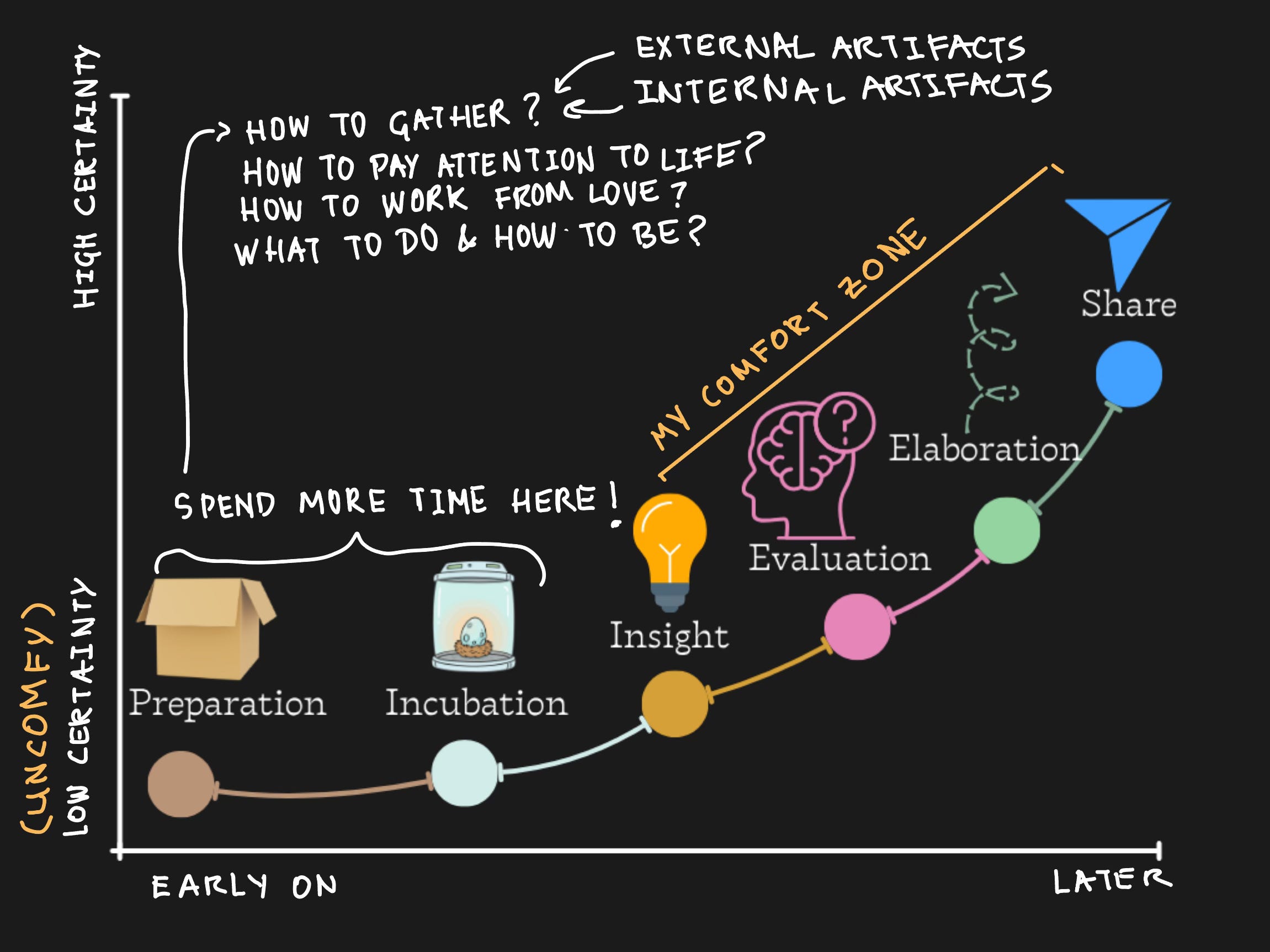
As I laid it out, I noticed how certainty moves through it. Low at the start, building slowly, only crystallising later on.
I am a sucker for higher levels of certainty. Many years in IT projects will do that to you.
Over time my mind has been well trained to operate in troubleshooting, planning and execution modes. The space before the problem exists feels a bit like my personal kryptonite.
Open-endedness makes me feel unproductive, so I avoid it. But in the context of being creative, the importance of spending time there suddenly dawned on me.
Csikszentmihalyi’s research showed this directly:
Artists who spent longer in open-ended exploration before defining what they were making, produced more original work. The ones who arrived with a pre-defined problem, produced more predictable work.
I want to get familiar with this space, to be more comfortable with higher levels of uncertainty and open-endedness.
But how?
Types of Attention
As a kid I never had strong sequential, verbal, and analytical skills - it did not come naturally to me. But out of necessity and over time, that mode seemed to take over my mental operating system.
Later in life I learnt how to move between L-Mode and R-Mode thinking as described by many including Betty Edwards (see image below for an explanation). In fact it is the R-Mode thinking we are trying to activate when we employ visual thinking tools.
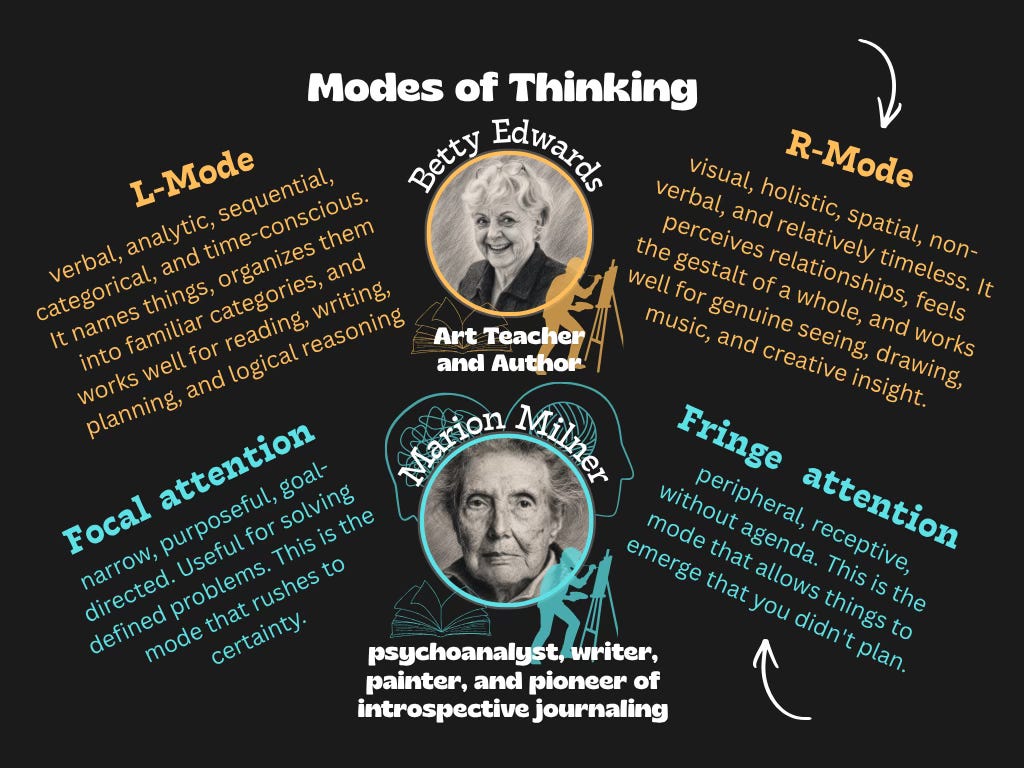
In my search for monsters, I came across Marion Milner (not a monster - see image above). She surprised me by describing my own crazy dash toward problem solving as a known human pattern.
She explains that a blank canvas brings anxiety. We rush to focal attention, which is narrow and goal directed, to ease that anxiety. There was the monster - a blank canvas we try to avoid.
She had discovered that fringe attention (peripheral, receptive, without agenda) is the mode that allows things to emerge that we didn't plan. And getting comfortable with fringe attention is a learnable skill.
My thoughts circled back to the creative thinkers that spoke about open-ended exploration, of receiving works through themselves, of feeling around in the dark for something that wants to be found.
Is this the attention they are employing? I want to experience more of that.
Fringe Attention And Early Stages of Creation
Not surprisingly, my exploration of visual tools has always fitted into the latter stages of the creative process. The stage where we use focal attention to state a specific topic, question or problem, to arrive at a solution, or to find the best way to structure it for sharing with an audience.
But how much raw material are we leaving trapped beneath the surface (inaccessible to even our AI, gasp! ) when we continuously operate in that focal attention? And how do we switch to fringe attention?
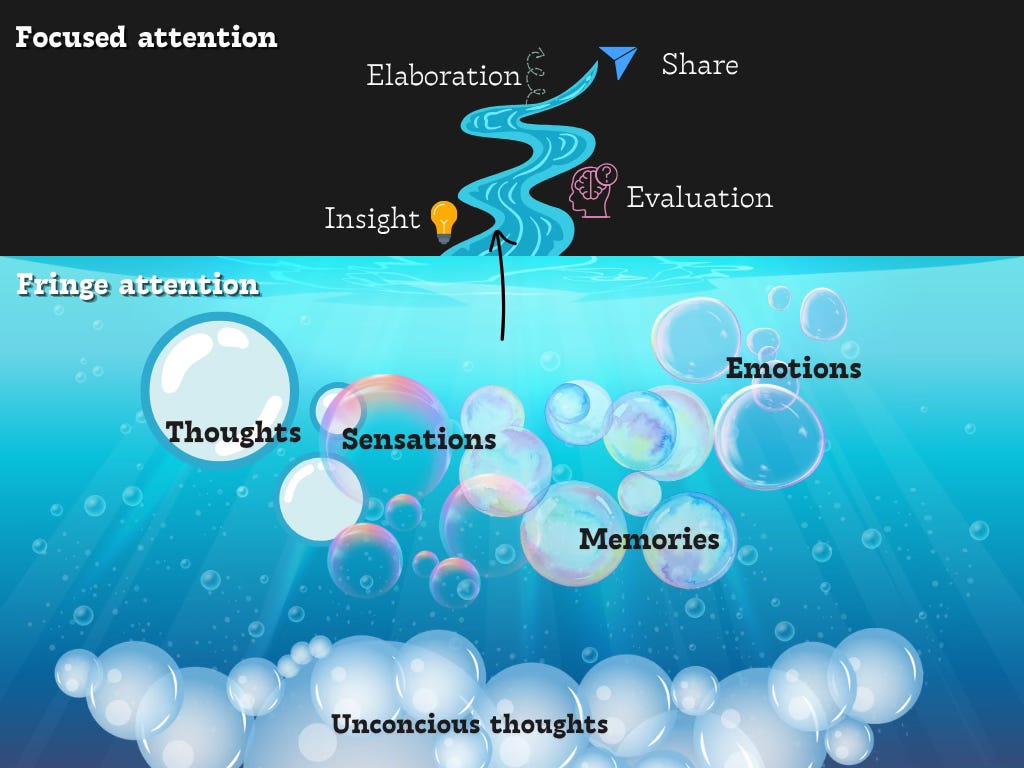
My mind automatically recalled Julia Cameron (Author of The Artist’s Way).
To unblock creativity, she developed a practice called Morning Pages:
Every morning, immediately upon waking, you write three pages longhand. Stream of consciousness. No agenda or editing and no showing to anyone. You write whatever random things that are in your head.
It seems to be a good way to surface things that may be at a lower conscious level using the Fringe attention. But I felt that the pure verbal and writing mode still strongly invokes our L-mode.
Since I was currently exploring visual tools, I wondered were there tools or activities that both invoked R-mode and used fringe attention?
And that is the first time the name Lynda Barry came across my radar.
Getting Back to Visual Tools
To be honest, I don’t think I would have appreciated what Lynda Barry had to teach, had I not recognised my discomfort with the early stages of the creative process. So I thought it was important to introduce her in the context in which she appeared.
While scanning her books “What It Is’ and “Syllabus” my brain felt as if it shifted into a dreamlike state. Her stories and the questions she posed in her own writing, woven in-between her fearless and expressive sketches, doodles and collages, engaged my mind at a deeper level than regularly formatted books.
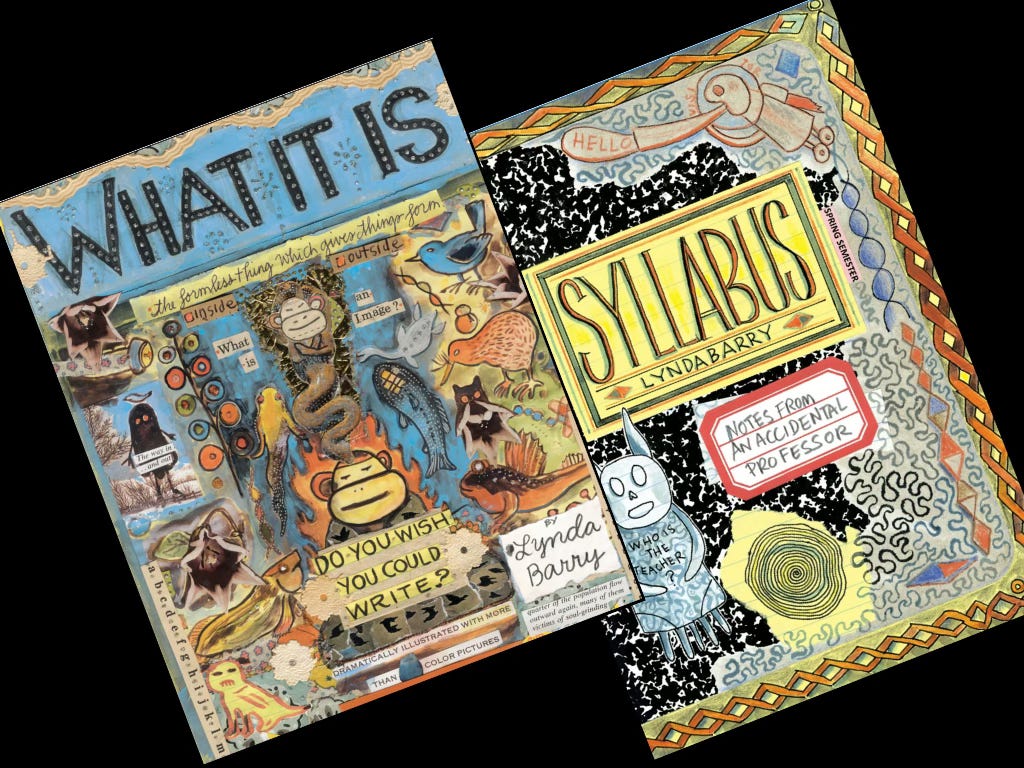
Her mission appears to be one geared towards helping humans pay attention to the back of the mind, where images are alive and beneath the conscious level, imbued with sensory, emotional and location information.
Working With Images
She makes a careful distinction between
a picture — something you make intentionally, with a plan, and
an image, something that arrives, that has its own life, that you didn't consciously design. It can be of something real or imaginary.
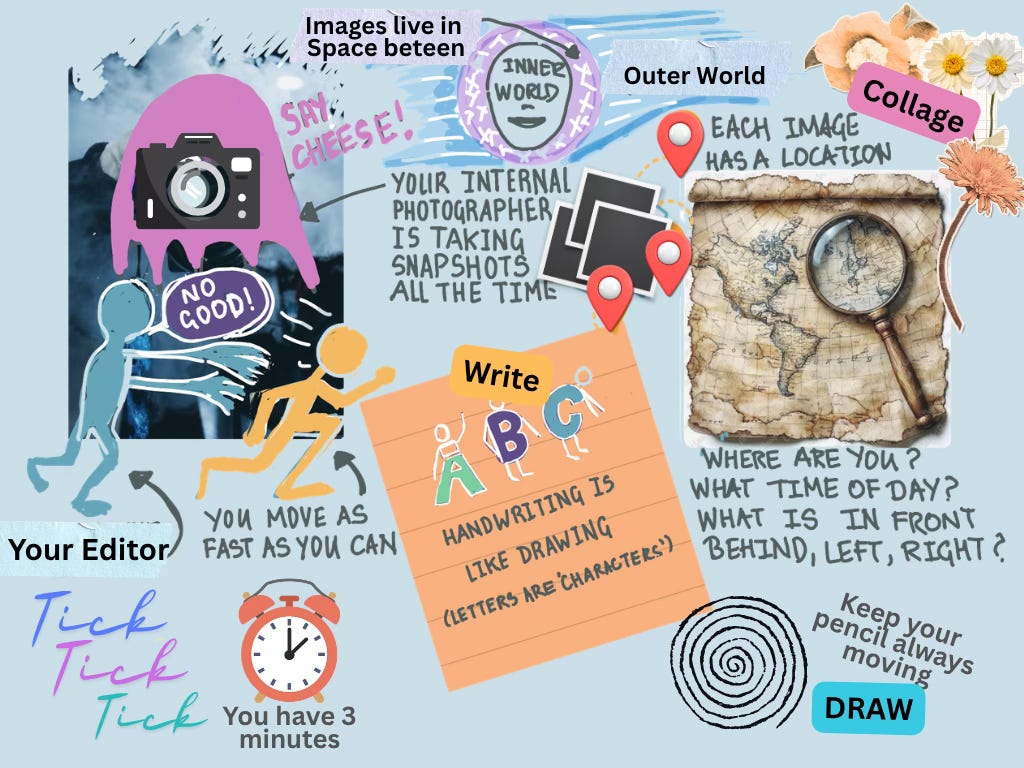
The image she refers to exists in the space between our inner world and the outer world. It's not fully inside or fully outside of us. We can access those images and use it to pull back a lot of rich information from our subconscious.
She urges the practitioner to build a daily habit with image making, through exercises that create the conditions for its arrival. She provides some tricks to outsmart our internal editor like timing ourselves for 3 minutes, closing our eyes while we draw, or only draw from memory.
Further we are not limited by skill. An image can be made from drawing, creating collages or just through word lists. She makes no distinction between writing by hand and drawing. All of these actions help us see the image in our imagination where we can begin to access more information.
An Exercise Example
I am just starting to practice working with her concept of an image. The most recent one was called sister image:
She guided us through the first step - drawing ourself for 3 minutes in a scene the previous day. In my scene I was sitting at my study desk and I’m engaging in a book club video conference call. I had to draw my full body in the position I was in and what was in front of me, and the background. After that we spent 3 minutes writing about the scene starting with “I am….”
Step two was to draw myself in a second panel in the exact position but as a kid or teen. The idea is to draw what comes to you that you were doing in that same position. My memory of a teen flowed incredibly clearly as I drew my childhood homework table, I saw my math books laid out, remembered the radio to my left playing a favorite song, saw the bed, the poster on the wall. At the end of 3 minutes I was able to start writing with ‘I am…’ totally immersed in the memory - even if my physical image was a scratchy low resolution representation of the scene.
Trusting The Process
These exercises I’ve started practicing are building a little more trust in spending time in what feels like chaos. There’s a whole lot more to explore here.
I started to build out a detective board - a digital white board that holds all my findings and experiments on visual thinking. I am excited to add all the experiments I will be doing using her tools.
I’m looking forward to spending a little time in this open ended exploration, being sensitive to what wants to be found.
I’m now acquainted with the blank canvas monster and I’m learning how to make him less intimidating.
As I end this leg of my visual thinking exploration, I share a final thought:
In the world of AI where things are constantly remixed from already externalised artefacts, learning to stay in the early phases of creation/uncertainty, may give us access to new ideas, perspectives or material that are not yet explicit and available.
Besides allowing us to birth new things into the world for others, it helps us unfold more of ourselves and explore this mysterious energetic field where things are eagerly waiting to be found.
Thanks for taking the journey with me. May you go forth and tame your own monsters.